
A Smartphone Brand
Growth Strategy Research Report
A Fortune 10 technology company's smartphone brand is losing market share in the US premium technology segment. The client engaged with us to understand how to stimulate growth and motivate different users to upgrade to our client's phone brand. We were also tasked to synthesize all past findings on this topic from the client to determine the key elements of the switching quest and clarify actionable steps to attract switchers.
My Role
Lead UX Strategist and Researcher
Skills
User Research, Interviews, Secondary Research
Research Synthesis, Research Themes
Mental Models, Data Visualization
Leadership Presentation & Engagement
Working with Research Vendors
Tools
Mural
Figma
Sago (Research Vendor)
Sprout Social
Timeline
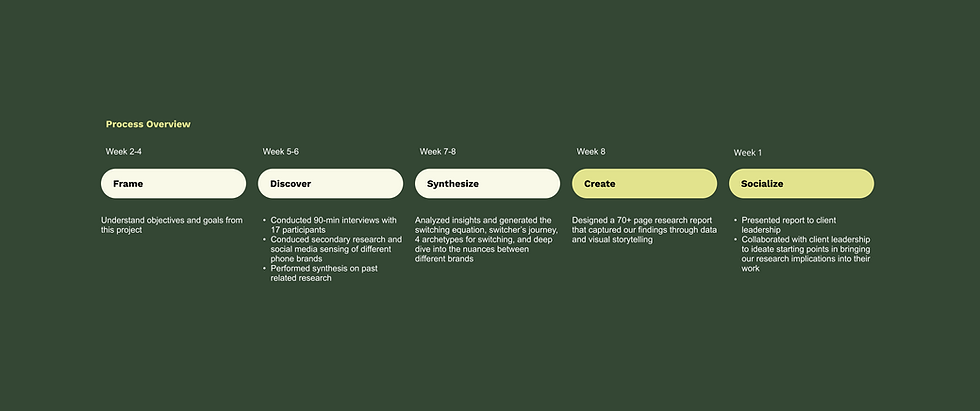
March 13 – May 12, 2023 (8 weeks)




Problem Space
Our client's premium smartphone brand was losing market share in the US segment. To stimulate growth, we needed to motivate smartphone users to upgrade to our client's brand (Switcher).
As part of Phase 2 of this project, we sought to capture the key elements to further understand the switching quest between different phone brands and clarify actionable steps to attract switchers.
Our Objectives
Understanding the Switching Quest
✅ Better understand the triggers for switching and the barriers preventing it
✅ Map the comprehensive switching journey with intervention points supported by pain points and/or fears
✅ Recommend the highest priority intervention points when reducing the barriers to switching to Pixel
A Deep Dive into the Switching Experience
✅ Understand the nuances amongst specific switcher categories/switchers between different brands
✅ Identify a switching equation to understand what switchers value
✅ Identify opportunity spaces, including marketing and retail implications, for potential switchers
Research Approach
Since our clients had us on the second phase of this project topic, we not only had to intake past related project information, but also synthesize this with our own research.
Synthesis of 5 past related studies
Analyzed past studied that directly and indirectly relate to our objectives




17 90-minute in-depth interviews (IDIs)
Conducted 90-min interviews with 22 participants (Switchers: 13, Considerers: 4)


Secondary research on the different smartphone brands
I led the competitive analysis and social media sentiment analysis of different smartphone brands using secondary research and Sprout Social


Research Interviews & Vendors
Selecting Participants
We worked with a research vendor to recruit our specific user groups. While this was in progress, we created the research stimuli for our interviews/co-creation activities.


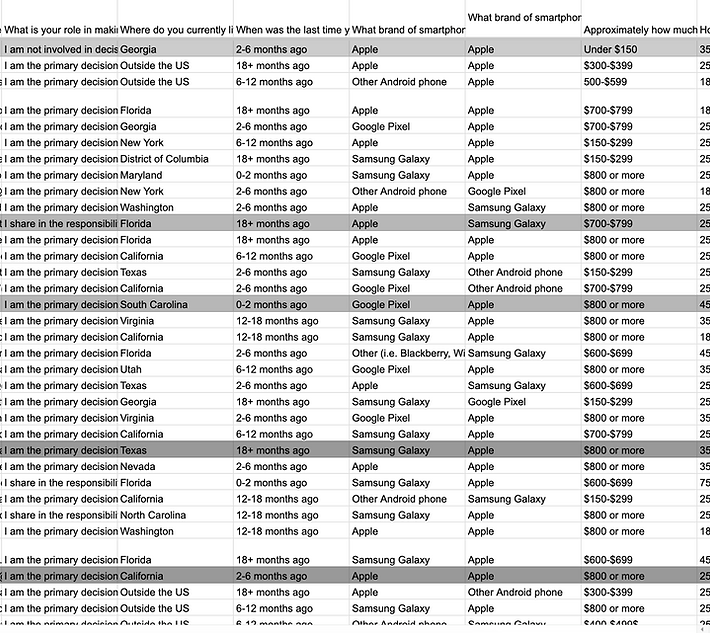
Due to the specificity of our target research group, when we didn't get enough participants, we had to think critically about finding the users ourselves. I created an online survey to share on social media and through friends/family and the Deloitte network. This recruited over 500+ responses that I parsed through to gain the final few participants we needed.

As I continued to find participants, we were actively conducting in-depth interviews (IDIs).
We wanted to probe into a user's thinking process when they consider switching their phone brand:
1️⃣ What are their frustrations/aspirations?
2️⃣ What was the "inciting incident" that pushed them to consider switching?
3️⃣ What activities did the users have that pushed them to decide to switch?
4️⃣ How did they buy the phone and set it up?
I collaborated with my co-lead and a manager to design the interview guide, then I designed our interview notetaking space on Mural so that it visually follows a timeline and the major milestones.


Research Synthesis & Insights
To begin capturing themes and insights, I created profiles for all 22 participants. This helped us capture the key points of each participant and reference back to them quickly.
To further understand our Switchers and Considerers, we used a quadrant diagram model to correlate how certain characteristics/motives led to different actions.


From my notes during the interview, I began to categorize information from their responses and focus on how users who switched between different brands behaved -- discovering the common themes/triggers for switching.
I also kept a quote board to tally the important findings from users that we could use in our story later.


I noticed there was a common pattern to phone users switching, so I organized these findings into an timeline so that it could better represent the switching user journey. Then from this, we could identify the nuances of switching between brands.
.png)
To further flesh out these key moments within the switching journey, I created emerging theme cards that double-clicked into a major moment. This helped us start thinking about the implications of these moments in the switcher's journey, real-life examples using precedents/analogs and collecting supporting evidence (quotes) from our research and past research.


Key Findings About How People Switch
But 4 quadrant model helped us differentiate user characteristics, but we wanted to create a memorable mental model of this information. I designed this into an equation on how switching occurs.
This equation helped us map how people measured within these two components, Vision and Agility. I gave titles to each of the 4 archetypes so we can easily reference back to them in our report. This also helped us determine which archetypes are our target audience/we can influence to switch.


Key Findings About Switching & Phone Brand Specific Journeys
Based on our interviews and the secondary research that I did, we captured that:
Perceptions and reality were not the same across phone brand journeys
Galaxy > Pixel switchers had expected the journey to be simple and were surprised and sometimes underwhelmed with the switch
iOS > Android switchers expected challenges in transfer and onboarding but the reality is not as difficult as they anticipated.
The ads and promotions are working!
When Galaxy > Pixel Switchers were making final decisions between Galaxy and Pixel phones it came down to promotions available
Switchers remembered ads that piqued their curiosity which influenced which phones they researched.
Social media influencer recommendations sometimes replace retail associates with tech-savvy switchers
Online reviews of products/unboxing videos are weighed heavily as a real source of information
Mental Models for Storytelling
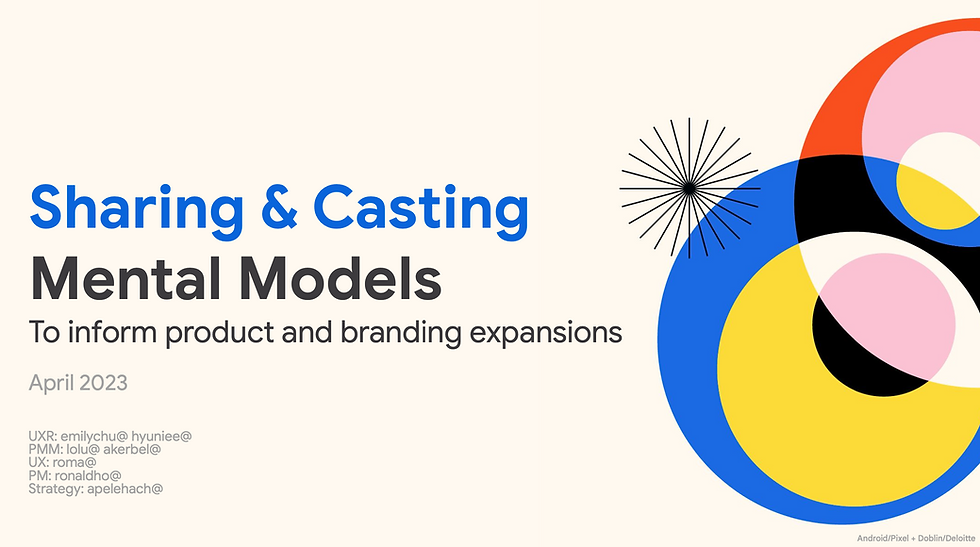
As the strategic design lead, I curated and aligned the design language of the final research report of 70+ pages. I represented our research insights using mental models and developed a "story" so that when we socialize with client leaders, it would be easier to understand and it would be more memorable.


Mental model development


Using the switcher's journey and the triggers we discovered that led to the act of switching phone brands, I designed an illustrative roadmap that depicts the obstacles and triggers of switching between different phone brands.
I aligned our mental models to share the same design language and ensure that our models would communicate to each other not only conceptually but also visually.


Tying it all together in a research report
To put together our final research report, we needed to understand what makes a good final report structure for our client or the story beats of successful projects. I started by going through past research reports and putting together notes to create an outline of how to deliver our insights.

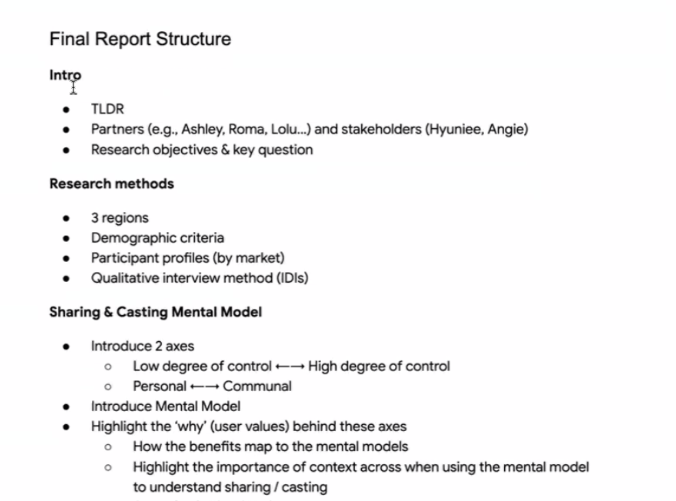
I used the motives of a journey/roadmap and elements from our equation mental model and applied this to the design language of the final research report.


My Takeaways
1️⃣ I learned how important it is to understand the ways of working with your client. Our client wanted to be very involved in this process, therefore we intentionally created more opportunities for client input. I learned about best practices and methods to bring our client along the journey.
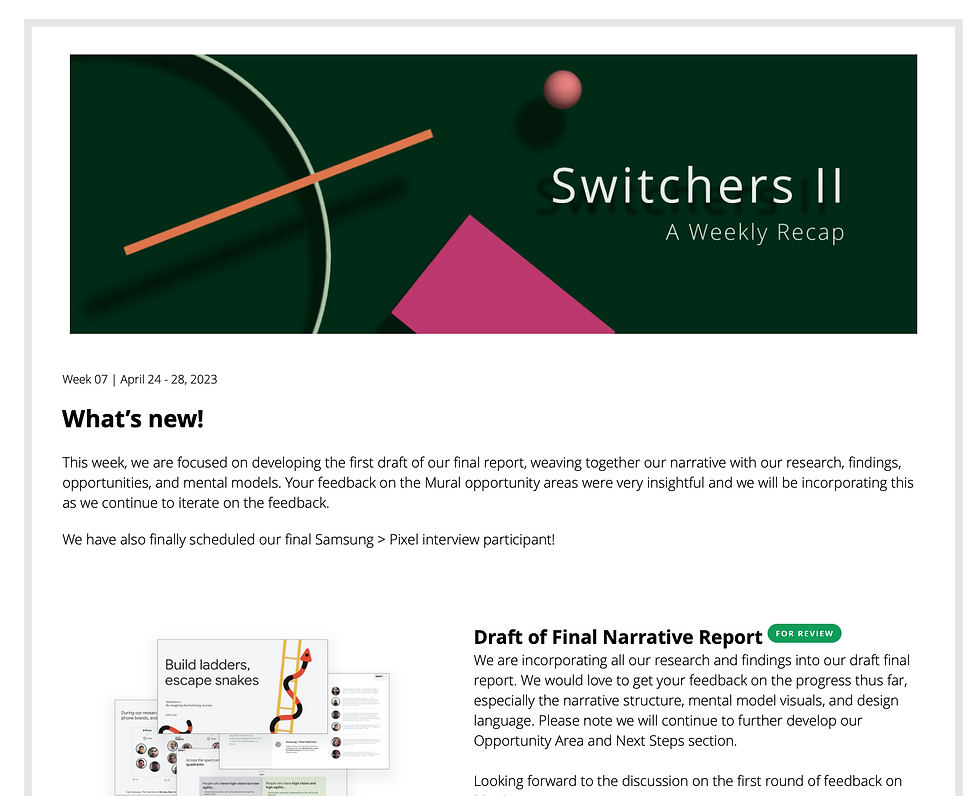
I made weekly newsletters to the leadership team
2️⃣ There's a difference between deck writing and research writing. A major portion of this project was to storytell this research in a compelling and memorable manner. I learned to take a creative approach to lead readers into your problem space and deliver information.
3️⃣ I learned to simplify mental models rather than overfill them with information. By implying designs, it not only becomes easier to comprehend and remember but also allows you to layer on more information later when needed.